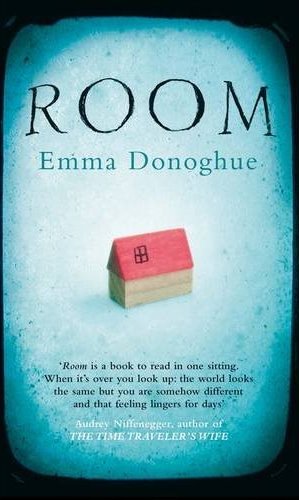
INITIALLY, I WAS PLANNING to read this book in my white Kindle3G but I was lucky to grab a hardcopy from my favourite charity shop for 1 pound only! So, I spared a few schellings instead of purchasing its ebook version from Amazon. I was intrigued by the title and cover design of it, not to mention that this is one of the popular and recommended reads in GoodReads and to date, Room is still one of the best selling books in UK. Without a doubt, this book is also included in the 2011 Booklist of UK Channel 4's The TV Book Club.However, I rated this book 3 out of 5 stars. Overall, I like the story, but not suitable for all ages! If I will recommend this for my mother (she is now 67 yrs old) to read, she might NOT be able to understand Jack's favourite children TV shows. On the other hand, I think the author is somehow able to manage enough to describe effectively of what a 5-yr old boy feels and thinks in embracing and enjoying life, together with his mother in a limited controlled environment. The planning and execution of Jack and Ma's escape are the best parts of the story! Unfortunately, Jack's new life outside the Room is not fully explored.Lesson learned? Well, Jack's story reminds us that sometimes we created our own private Rooms which have limited access to other people or we do not want that every one could dwell inside. Maybe these Rooms provide us comfort, strength and encouragement to move on with our lives. Ultimately, these Rooms become our refuge and to some extent, we do not want to get out from these "comfort zones" and not taking risks to explore outside our Rooms, afraid to confront our fears to fail! In terms of child development, our parents play an important role in shaping our personalities and to prepare us in embarking with so called – life! Early development is a crucial stage in our young lives to be socially and psychologically prepared to embrace life. Of course, there are external forces that influence our young behaviours, but again with the proper guidance from our parents, the negative impacts/effects from these forces can be minimised or can be handled accordingly!
Speaking of externalities, television and other media/entertainment devices (interactive games, computers, DVD players, etc.) are major influential factors in growing-up. For instance, my cousin's youngest son (turned 3 last December) manages to operate an iPad and watched his favourite heroes cartoon programmes in Youtube! Consequently, he does heroes stuff – doing heroes iconic moves while wearing Batman, Spiderman and Ironman co stumes in a day! Believe me, he is not crazy and being an Uncle, I am amused while watching him. Of course, there is limitation about this and when his parents come into picture, he does his tantrums – manageable to handle just diverting his attention.
A 2006 US survey conducted by the Kaiser Family Foundation shows that 75% of children under 6 years old watch some TV in a given day (www.ehow.com). Moreover, the study found out that children age 6 and under who watch television spend an average of one hour, and total "screen time" with these media gadgets goes up to nearly four hours and 30 minutes per day. There is a "misconception" among parents that allowing kids/babies to watch TV is educational. But according to the American Academy of Pediatrics (AAP), no screen time for childre n under 2 years old to prevent a reduction in communication and language skills. In addition, study also revealed that each hour of television per day results in a 2.68 decrease in a baby's language score. It is recommended that after the age of 2, parents could try to 1 or 2 hours of quality programming. On the other hand, the Nemours Foundation observes that, "in moderation, television can be educational in addition to entertaining - preschoolers can get help learning the alphabet on public television [and] grade-schoolers can learn about wildlife on nature shows." I think that "moderation" is the key when it comes to allowing young children to watch TV and other screen media. It is viewed that excessive viewing habits (more than four hours per day) can hamper with other aspects of a child's life development – physical activity and socialisation.
By the way, I took the Channel 4 TV Book Club's quiz and I got 83% (two mistakes out of 12 questions). I thought got it all right. Well, Jack thinks I'm clever as his Ma! I took it again and of course I answered them correctly – Jack's thinks I'm so clever but he will probably be that clever (like me) when he turns six!
If you want to know more about the author's inspiration to write, then visit this link: Emma Donoghue.
FINALLY, THIS STORY also reminded me of the American girl, Jaycee Lee Dugard being captive for 18 years. After her disappearance at age 11, her story became a world-wide sensation in August 2009. Maybe majority of us book fanatics thought that Donoghue's novel is based on her captivity experience. Unfortunately, Donoghue reveals that she got the inspiration to write Jack's life from the Austrian Fritzl's case.
"In Room we knowed what everything was called but in the world there's so much, persons don't even know the names" - Jack
 THE NOVEL, 'ROOM' IS THE WINNER of the 2010 Goodreads Choice Award for Fiction. The author, Emma Donoghue is answering questions about the book - a gripping story of a mother and son held captive in an 11x11 foot space. Goodreads set-up a GROUP which allows members to have a direct communication with the author herself from 21-25 March 2011. I posted my own personal question about the settings of Room. I asked:
  Emma: I wanted it be set in America so that the country Ma and Jack emerge into would be one with a strong sense of itself as everyone's happy ending - land of freedom and prosperity, etc. Ma's not an immigrant, it's just that - despite the best efforts of my publishers' copyeditors! - I'm afraid some of my phrasing is not standard American. As for the title 'Ma', I just didn't want the typical modern American one of 'Mom', as Ma and Jack are such outsiders, so I went for one (Ma) that I associate with nineteenth-century America (Little House on the Prairie, anyone?). In Ireland we say Mammy, Mum, Ma or (increasingly) Mom. Q4: Why was Ma adopted? What relevance does that add to the story?" Emma: Oh, this is a touchy one, isn't it? People have such strong and clashing views on adoption. I see it as normal, myself, having many friends who have either been adopted or have adopted. I'm the birth mother in my own family, so my partner is technically/legally an adoptive mother, and perhaps that shapes her bond with the kids in some ways but it doesn't make it any less powerful. Well, anyway, for what it's worth, here are some reasons I made Ma adopted:(a) I knew readers would be longing for her to get back to the normal world, the happy-nuclear-family world, and when it finally happens I wanted her family to have a realistic modern feel. Having the parents split up was one way of doing that (especially since so many couples do break up when a child goes missing) and having her be adopted was another. (b) Because in Room it might seem like her and Jack's closeness grows out of their birth bond, I wanted to show that birth is not the only way for such motherlove to happen.(c) I liked the notion of Ma's unseen birth mother as someone haunting the novel, a parallel for Ma, a young woman under unidentified pressures who makes the very different decision to give her child up. FINALLY, EMMA REVEALED THAT SHE received numerous offers for a film adaptation of Room but to date, nothing formalised yet. Personally, this is something to look forward to especially the on-screen characterisation of Jack. I've also learned that the audio version of the book is available and it got excellent reviews too.